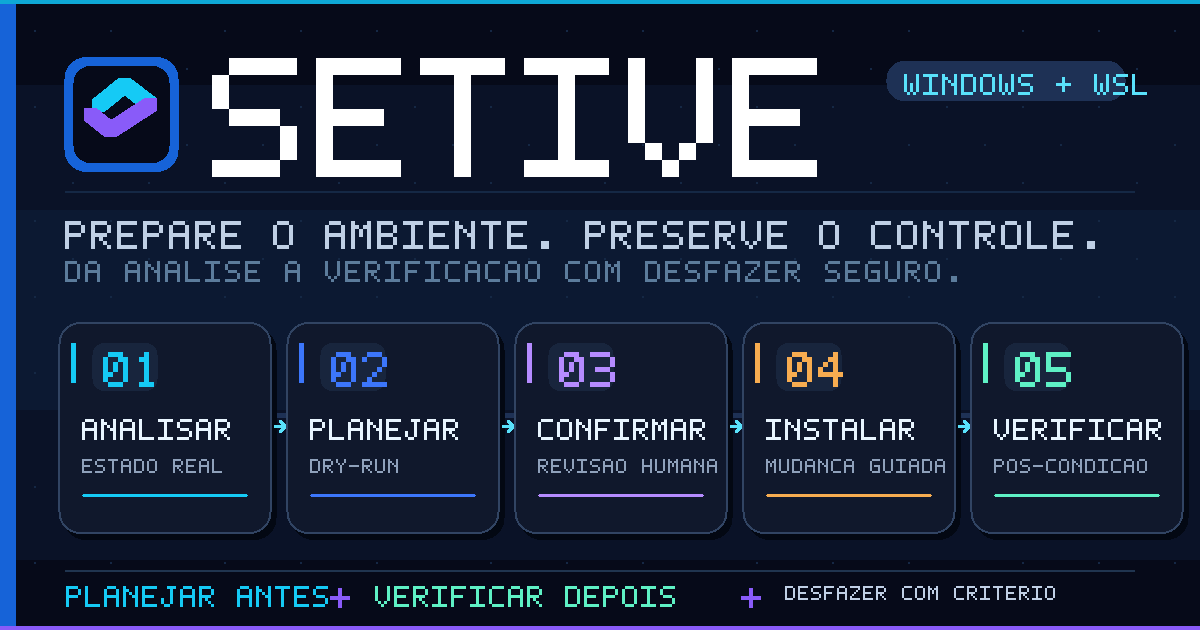
Setive: preparing Windows and WSL without overwriting a developer's environment
Pure planning, idempotency, real-state verification, and safe undo: Setive's engineering decisions and documented testing limits.
Blog
Technical notes on architecture, digital products, AI, and software delivery.
Subscribe via RSSPure planning, idempotency, real-state verification, and safe undo: Setive's engineering decisions and documented testing limits.

How a Next.js configurator turns answers into an exportable static website without a mandatory backend, while preview and production share one source of truth.
How to surround a probabilistic component with deterministic invariants for credits, privacy, idempotency, leases, and cost in an AI product.
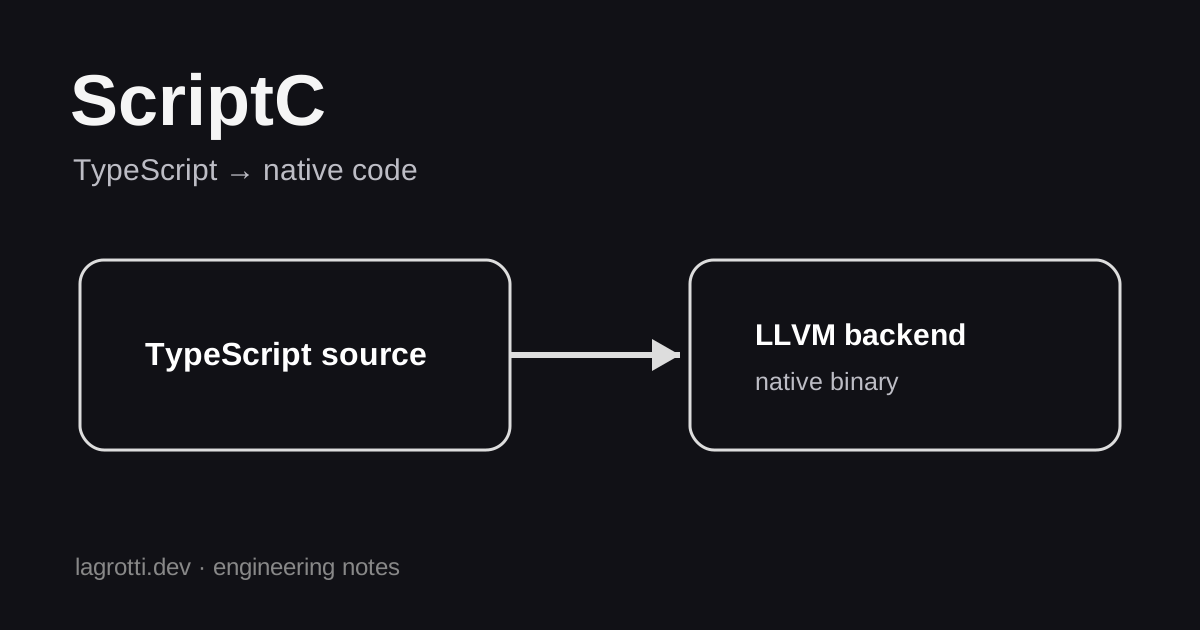
ScriptC compiles TypeScript to native binaries through LLVM and only embeds a JavaScript engine when you opt into dynamic mode. I looked at where it fits, what it does not replace, and where I would try it.
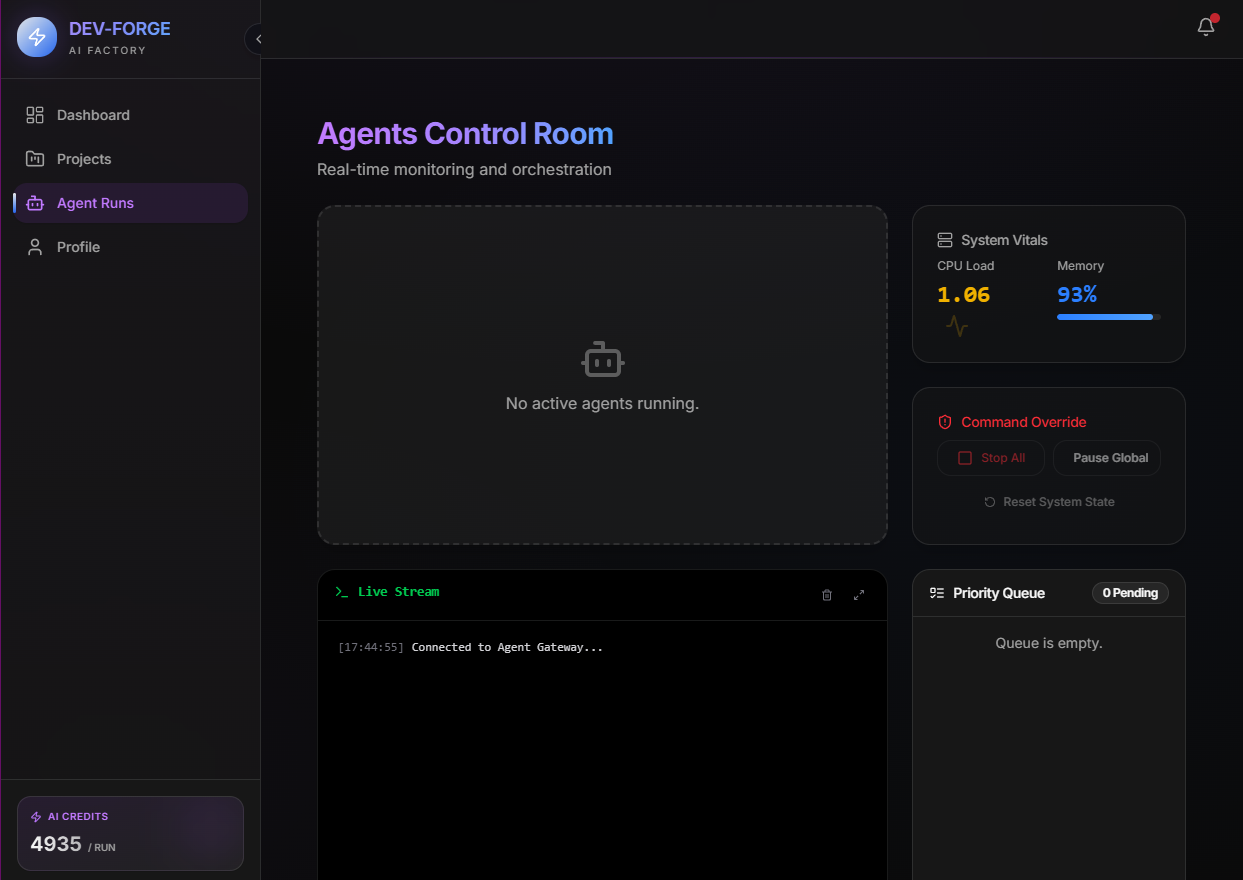
Coding agents made code cheaper to produce. That did not make architecture, readability, and testing less important — it changed where those principles need to be enforced.
Kimi K3 and K2.8 push coding agents toward huge context windows. Useful, yes—but loading an entire repository is not a substitute for retrieval, tools, tests, and a good harness.
Kimi, Jev, the Agents API, and modern coding agents make one thing clear: differentiation is moving from the standalone model to the harness, tools, controls, and verification.
Jev proposes a different layer for agents: typed decisions, probabilities, and confidence. The point is not replacing LLMs, but stopping the habit of using them everywhere.
What changed in how I understand MCP: stateless protocol design, authorization, tools, private environments, Tasks and why connecting an agent to real systems is an architecture and security problem.
How I designed a local pipeline for sensitive corporate data: irregular Excel files, normalization, local AI, verifiable rules, human correction and Power BI without making a chatbot the source of truth.
After years of JavaScript and Node.js, I added Python and FastAPI to my AI stack—not because of hype, but because different ecosystems deserve different boundaries.
The architecture and trade-offs behind DevAgent: an agent that reads a task, changes code, runs checks, and delivers a pull request humans can review.
How I built Praxis: one goal tree rendered as a 2D map, list and 3D constellation, with derived progress, cycle prevention, collaboration and optional AI.
What I learned building Flora Psicologia: technical SEO, content without sensationalism, simple scheduling, sensitive data and an architecture designed around trust instead of aggressive conversion tactics.
How I modeled Eurologado: AI for drafting and organizing, structured rules for validation, versioning, evidence and audit trails in a regulatory domain.
Behind the Estúdio Dupla Face portal: interactive floor plans, responsive coordinates, RLS, private documents with signed URLs and a public site that can survive database failures.
How I modeled an on-demand 3D printing store with browser preview, auditable approval, modular boundaries and tests focused on the irreversible risk of physical production.
How I built Digital Tech MS: server-side configurable pricing, quotes, immutable order snapshots, artwork approval and a production flow that treats physical mistakes as business risk.
Behind PulseWatch: health checks, state transitions, thresholds, multi-channel alerts, multi-tenant isolation and the decisions that keep monitoring from becoming noise.
What I learned migrating a marketing analytics SaaS to an event-driven architecture with Kafka, Go, ClickHouse and PostgreSQL without stopping the product.
How I designed my portfolio to prove engineering decisions, tell real project stories, and build trust before the first conversation.